WhatsApp CRM vs Regular CRM: What's the Difference?
A CRM helps businesses organise customer information, manage leads, track sales and maintain relationships. But the way customers communicate with businesses has changed.
Many customers now prefer instant messaging over forms, emails or phone calls.
This has created a growing need for WhatsApp CRM software—a CRM solution that connects customer management directly with WhatsApp conversations.
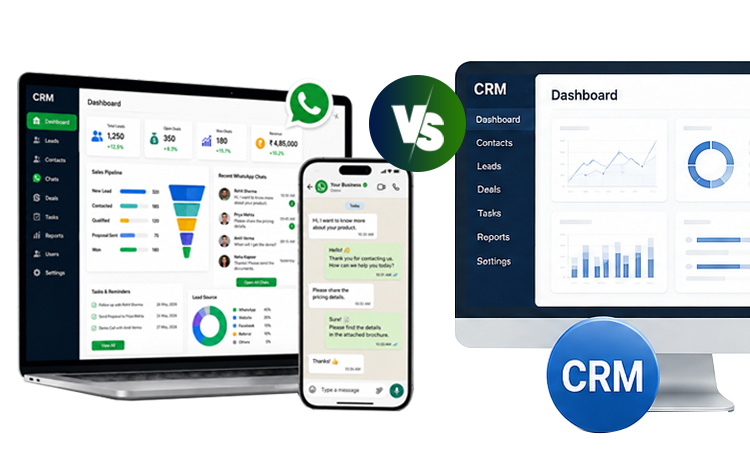
So, how does a WhatsApp CRM vs regular CRM comparison actually work?
The answer is not that one system is always better than the other. They are designed around different communication and operational needs.
The reference article makes the same basic distinction: WhatsApp CRM brings customer conversations into a WhatsApp-connected workflow, while traditional CRM platforms focus more broadly on contact management, sales pipelines, tasks, reporting and multiple integrations.
What Is a WhatsApp CRM?
A WhatsApp CRM connects WhatsApp conversations with customer relationship management features.
Instead of keeping customer chats in one place and sales information somewhere else, a WhatsApp CRM can bring them together.
Depending on the platform, teams can use it to:
- Manage WhatsApp conversations
- Capture leads
- Assign chats to sales agents
- Track customer information
- Automate replies
- Create follow-up workflows
- Segment customers
- Manage sales pipelines
- Connect WhatsApp with other business tools
The reference article describes WhatsApp CRM as a system that centralises WhatsApp conversations while allowing teams to track interactions, automate responses and maintain customer context.
What Is a Regular CRM?
A regular CRM, often called a traditional CRM, is a broader customer management platform.
It typically stores customer and company information and helps sales, marketing and support teams manage relationships across different stages.
Common CRM capabilities include:
- Contact management
- Account management
- Lead tracking
- Sales pipelines
- Tasks and follow-ups
- Reporting
- Email integration
- Call tracking
- Third-party integrations
The uploaded reference specifically describes regular CRM systems as centralised platforms for managing customer information, interactions, sales processes and reporting.
WhatsApp CRM vs Regular CRM: Quick Comparison
| Feature | WhatsApp CRM | Regular CRM |
|---|---|---|
| Main communication focus | WhatsApp conversations | Multiple communication channels |
| Customer chat management | Strong | Usually requires integration |
| WhatsApp integration | Built around WhatsApp | Often added through integration |
| Lead capture | Directly from WhatsApp | Forms, website, email and other sources |
| Chat automation | Strong | Usually broader workflow automation |
| WhatsApp chatbot | Common | Usually requires an additional tool |
| Sales pipeline | Yes | Yes |
| Contact management | Yes | Yes |
| Email management | Depends on platform | Usually strong |
| Multi-channel management | Depends on platform | Usually strong |
| Reporting | Sales + conversation focused | Broad business reporting |
| Best for | WhatsApp-first businesses | Multi-channel and complex organisations |
The reference comparison similarly separates WhatsApp CRM around real-time messaging and chat workflows from traditional CRM's wider business-process functionality.
7 Major Differences Between WhatsApp CRM and Regular CRM
1. Communication Channel
The biggest difference is how customer communication is handled.The biggest difference is how customer communication is handled.
WhatsApp CRM
WhatsApp is at the centre of the customer journey.
A customer can message your business and the team can manage the conversation alongside customer information, lead status and follow-up activities.
Regular CRM
A regular CRM is usually designed to manage communication across broader channels such as email, phone, website forms and other connected systems.
The reference article identifies WhatsApp CRM as real-time and chat-focused, while regular CRM is more structured around broader communication processes.
2. Customer Experience
WhatsApp offers a conversational experience that most customers already understand.
Instead of filling out a form and waiting for an email, customers can simply send a message.
For example:
Customer: I need a quotation.
Business: Sure. What service are you interested in?
The conversation can continue naturally.
A regular CRM can still manage this customer, but WhatsApp usually needs to be connected through an integration.
WhatsApp CRM advantage:
The conversation and customer record can stay closely connected.
3. Automation and Chatbots
Automation is another major difference.
A WhatsApp CRM can trigger workflows based on customer actions.
For example:
New WhatsApp enquiry → Automated greeting → Lead qualification → Sales assignment → Follow-up
Businesses can automate:
- FAQs
- Lead qualification
- Appointment reminders
- Follow-ups
- Order notifications
- Customer updates
- Welcome messages
Regular CRM systems can also automate processes such as lead scoring, task creation and email follow-ups, but WhatsApp-specific conversational automation may require additional integrations.
4. Lead Capture and Qualification
Suppose a potential customer clicks a WhatsApp ad.
With a WhatsApp CRM, the conversation can become the starting point of the sales process.
The system could ask:
What product are you interested in?
What is your budget?
When do you want to purchase?
The answers can then be used to classify and route the lead.
This can reduce manual data entry and help sales teams respond faster.
The reference article highlights lead capture, qualification and routing as important WhatsApp CRM use cases.
5. Sales Pipeline Management
Both types of CRM can manage sales pipelines.
The difference is how the conversation gets into that pipeline.
With a regular CRM:
Website form → Lead record → Sales representative → Follow-up
With a WhatsApp CRM:
WhatsApp message → Lead captured → Qualification → Sales representative → Follow-up
For businesses that generate many leads through WhatsApp, the second workflow can feel much more natural.
6. Integrations
A regular CRM usually has a broad ecosystem of integrations.
It may connect with:
- Accounting software
- ERP
- Marketing platforms
- Websites
- E-commerce systems
- Customer support tools
- Analytics platforms
WhatsApp CRM platforms may focus more heavily on WhatsApp Business API integration and messaging-related workflows.
This does not mean WhatsApp CRM cannot integrate with other systems.
In fact, a strong WhatsApp CRM should connect WhatsApp with the rest of your business technology.
The difference is mainly where the CRM experience is centred.
7. Cost and Complexity
A large traditional CRM can involve:
- More features
- More configuration
- Longer implementation
- More user management
- More integrations
- More training
That may be exactly what a larger organisation needs.
A WhatsApp-first CRM can be simpler for businesses whose customer journey revolves mainly around messaging.
The reference article similarly positions WhatsApp CRM as quicker and more accessible for smaller and direct-to-consumer teams, while traditional CRM is better suited to more complex enterprise workflows.
However, cost should not be judged simply by the subscription price.
Consider:
Software cost + implementation + employee time + missed leads + manual work
WhatsApp CRM or Regular CRM: Which One Should You Choose?
There is no universal answer.
Your choice should depend on how your customers communicate and how your sales process operates.
Choose a WhatsApp CRM when:
- Most customer enquiries arrive through WhatsApp
- You sell directly to consumers
- Your team needs fast conversations
- You want WhatsApp automation
- You need WhatsApp lead qualification
- You want a shared WhatsApp inbox
- You want chatbots
- Your sales team depends heavily on WhatsApp follow-ups
The reference article identifies D2C, e-commerce, appointment-based businesses, local businesses and startups as strong use cases for WhatsApp CRM.
Choose a Regular CRM when:
- Your business operates across many channels
- Your sales process is long and complex
- Multiple departments use the CRM
- You need advanced reporting
- You have complex account management requirements
- You rely heavily on email and calls
- You require extensive ERP, BI or marketing integrations
The reference article describes traditional CRM as particularly useful for longer sales cycles, multi-stage workflows and multi-department operations.
Can WhatsApp CRM and Regular CRM Work Together?
Yes—and this can be the best option for many businesses.
You don't always need to choose between the two.
For example:
Website + Email + Sales Pipeline + ERP + Analytics
can remain inside your regular CRM.
At the same time:
WhatsApp conversations + WhatsApp automation + WhatsApp lead capture
can be connected to that CRM.
This creates a more complete customer journey.
Example
A customer sends a WhatsApp message.
WhatsApp CRM captures the conversation.
The lead is created in the main CRM.
The sales team receives the lead.
Customer data is updated.
WhatsApp automation sends the required follow-up.
This approach combines the strengths of both systems.
What Is the Best CRM for WhatsApp?
The best CRM for WhatsApp depends on your requirements.
Before selecting a platform, check whether it supports:
WhatsApp Business API
Your CRM should use an appropriate official WhatsApp integration rather than relying on unofficial workarounds.
Shared Team Inbox
Multiple team members should be able to manage conversations efficiently.
Lead Management
You should be able to capture, assign and qualify leads.
Automation
Look for workflows that can handle repetitive communication.
Chatbots
Useful for FAQs, lead qualification and first-level support.
CRM Integration
If you already have a CRM, make sure the WhatsApp solution can connect with it.
Analytics
You should be able to understand conversations, campaigns and sales activity.
Scalability
The platform should be able to grow with your communication volume and team.
WhatsApp CRM for Sales Teams
A WhatsApp CRM can be particularly useful for sales teams.
Instead of switching between:
WhatsApp → Spreadsheet → CRM → Email → WhatsApp
the team can work from a more connected workflow.
A sales representative can see:
- Customer details
- Previous conversations
- Lead status
- Follow-up reminders
- Assigned team member
- Customer interests
- Sales stage
This reduces context switching.
WhatsApp CRM for Customer Support
Support teams can also benefit from a WhatsApp CRM.
Automations can handle simple queries while more complex issues can be transferred to an agent.
For example:
Customer: Where is my order?
Automation: Please enter your order number.
Customer: #10452
System: Your order is currently out for delivery.
The support agent can then step in when needed.
This creates a combination of automation + human support.
WhatsApp CRM for Marketing
WhatsApp can also be used for customer engagement and marketing.
Businesses can use a WhatsApp CRM to organise customers based on factors such as:
- Previous purchases
- Customer interests
- Lead source
- Engagement
- Location
- Product category
This makes it easier to send relevant communication rather than sending the same message to everyone.
Marketing communication should always follow applicable WhatsApp requirements and customer consent rules.
How CoreConnect360 Fits Into WhatsApp CRM
CoreConnect360 is built around WhatsApp Business API-powered customer communication.
Its platform positioning combines WhatsApp communication with capabilities such as automation, AI chatbots, CRM integration, analytics and customer engagement.
This can help businesses move from:
WhatsApp as a Messaging Tool
to
WhatsApp as a Customer Management Channel
For example:
Lead comes from WhatsApp → AI/chatbot qualifies lead → CRM stores information → Sales agent takes over → Follow-up is automated
That is the real value of a WhatsApp CRM.
Final Verdict: WhatsApp CRM vs Regular CRM
A regular CRM is a broader customer-management system designed to support complex sales, marketing and service operations.
A WhatsApp CRM puts WhatsApp conversations at the centre of customer engagement and connects those conversations with CRM functionality.
So the right choice depends on your business.
Choose WhatsApp CRM when:
Speed + conversations + WhatsApp + automation are your priorities.
Choose Regular CRM when:
Complex workflows + multiple channels + departments + advanced reporting are your priorities.
Choose both when:
You want to combine WhatsApp engagement with a broader business CRM ecosystem.
The goal isn't to choose the most complicated CRM.
Choose the system that fits the way your customers actually communicate.